Is your air conditioner running, but you’re still sweating in your own living room? “Low gas” is the most common diagnosis technicians give for weak cooling, but it is also the most misunderstood.
In Malaysia, aircond gas scams are common. Many homeowners pay for top-ups they do not need. A properly installed system is sealed and should rarely need new refrigerant.
This guide will explain exactly how the system works, the correct prices for 2025, and how to tell if you have a genuine leak. By the end, you will know how to avoid unnecessary costs and keep your unit running cold.
What is Aircond Gas?
“Gas” is the refrigerant, the chemical fluid that absorbs heat from your room and releases it outside. Without it, your air conditioner is just a fan.
In Malaysia, we use three main types of refrigerant. The Department of Environment (DOE) is actively managing these under the HCFC Phase-out Management Plan (HPMP) to protect the ozone layer.
| Refrigerant Type | Status in Malaysia | Efficiency | Estimated Cost (Per 20 PSI) |
|---|---|---|---|
| R22 | Phasing Out (Import ban active) | Lower | RM 20 - 30 (Harder to find) |
| R410A | Common | Medium | RM 30 - 40 |
| R32 | Current Standard | Highest | RM 30 - 40 |
Important: Most new units from brands like Daikin and Panasonic now exclusively use R32. It has a lower Global Warming Potential (GWP) and cools more efficiently than its predecessors. If you have an old R22 unit, be aware that parts and gas are becoming more expensive as the 2030 complete phase-out deadline approaches.
Does Aircond Gas Run Out?
In theory: No. Your air conditioner is a closed-loop system, similar to a refrigerator. The gas circulates repeatedly; it does not get consumed or evaporate during normal operation. A unit installed perfectly can run for 10 years without ever needing a top-up.
In reality: Yes, but only due to leaks. Gas levels drop for specific mechanical reasons:
- Vibration: Years of operation can loosen the flare nuts connecting the pipes.
- Corrosion: Malaysia’s humidity can cause copper pipes to corrode, creating pinhole leaks.
- Poor Installation: If the installer did not flare the copper pipes correctly, gas will escape slowly over the first few months.
Signs Your Aircond Needs Gas
Before you call a pro, look for these physical symptoms.
- Weak Cooling The air coming out is cool, but not cold. It feels like a fan rather than an air conditioner.
- Ice on the Copper Pipes Check the outdoor unit. If you see white frost or ice on the smaller copper pipe (discharge line), this often indicates low gas pressure. Note: Ice on the larger suction pipe usually points to a dirty filter, not low gas.
- Hissing Sound A distinct hissing noise near the indoor or outdoor unit usually means refrigerant is actively escaping.
- Continuous Running The compressor outside never turns off because it cannot reach the temperature you set on the remote.
- High Electricity Bills When gas is low, the unit works twice as hard to cool the room, spiking your TNB bill.
Diagnosing Gas Level
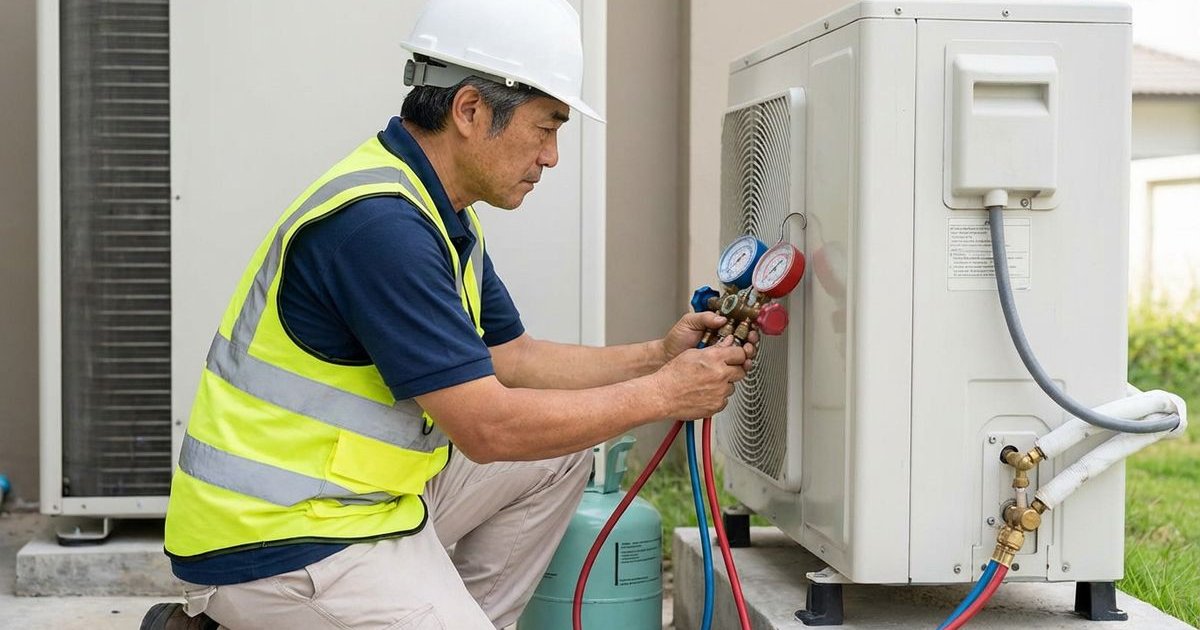
You can ask your technician to show you the pressure readings. This is the only way to be sure. They should use a manifold gauge to check the suction pressure.
Here are the standard operating pressures for a running unit in Malaysia (approximate, as ambient temperature affects readings):
- R22: 60 - 75 PSI
- R410A: 120 - 150 PSI
- R32: 120 - 150 PSI
Insider Tip: If a technician claims your gas is low but the gauge reads within these ranges, ask them to explain why. Do not accept “it looks low” without seeing the numbers.
Gas Top-Up Process
If you genuinely have low gas, the technician must follow a specific procedure. It is not just “filling it up.”
- Check Pressure: Connect gauges to the service port on the outdoor unit.
- Leak Check: Use soapy water or an electronic leak detector to find the escape point.
- Vacuuming (Critical): If the system is empty, they must use a vacuum pump to remove air and moisture before refilling. Moisture inside an R32 or R410A system will destroy the compressor oil.
- Refill: Add refrigerant by weight or pressure until it reaches the correct level.
- Test Run: Monitor the cooling performance for 15 minutes.
Cost of Gas Top-Up in Malaysia (2025)
Pricing varies based on how much gas you need. A “top-up” adds a small amount, while a “full recharge” is for empty systems (usually after a leak repair).
| Service Scenario | Estimated Cost (RM) |
|---|---|
| Minor Top-Up (10-20 PSI) | RM 50 - RM 80 |
| Moderate Top-Up | RM 100 - RM 180 |
| Full Recharge (Empty System) | RM 180 - RM 280 |
| Leak Repair + Refill | RM 250 - RM 500+ |
Note: R22 gas is becoming scarcer. Some technicians may charge a premium for it simply because the supply is limited by government quotas.
With or Without Leak Repair?
This is the most critical decision you will make.
Option A: Top-Up Only
You pay less today (e.g., RM 80). However, the hole remains. The gas will leak out again—maybe in a week, maybe in a month. You are essentially throwing money into the air.
Option B: Fix Leak + Top-Up
This costs more upfront (e.g., RM 300) because the technician must find the leak, re-flare the pipes, or weld the copper. But once fixed, the problem is solved permanently.
Our Advice: If you have to top up gas more than once every two years, you have a leak. Pay for the repair. Continuous top-ups are a waste of money.
How Often is Gas Top-Up Needed?
“My aircond man says I need to top up gas every time I service the unit.”
This is false. If your unit was installed correctly, you might never need a top-up. A sealed copper system does not consume gas.
- Properly Installed Unit: 5-10 years without top-up.
- Unit with Slow Leak: Needs gas every 6-12 months.
- Unit with Major Leak: Needs gas every few weeks.
Common Misconceptions
Don’t fall for these myths.
”Cheap servicing = low gas”
Some dishonest technicians advertise a “RM 50 Chemical Wash” to get into your house. Once there, they claim your gas is low to charge you an extra RM 100. This is the classic “bait and switch.” Always check the pressure yourself.
”More gas = colder air”
False. Overcharging an air conditioner is dangerous. If the pressure is too high, the compressor can overheat or fail. The system needs the correct amount, not the maximum amount.
”I can top up gas myself”
Not Recommended. R32 is mildly flammable. Handling it requires specific tools and safety training. Furthermore, releasing refrigerant into the air is illegal under environmental laws.
Questions to Ask Your Technician
Protect yourself by asking these questions before they start work:
- “Can you show me the pressure gauge reading before you top up?”
- “Is this R32 or R410A gas?” (Ensure they use the correct type for your unit).
- “Where is the leak located?” (If they can’t find it, a top-up is only a temporary patch).
- “Does your price include checking for leaks with soapy water?”
Gas Top-Up with 1-Month Warranty
At KL1 Aircond, we believe in transparent pricing. All gas top-up services come with a 1-month warranty on gas leaking — if there’s a leak within 30 days, we fix it at no extra cost.
We ensure your unit leaves our care in perfect working condition, with no hidden “low gas” surcharges.
Signs It’s NOT a Gas Problem
Sometimes, the unit isn’t cold, but the gas is fine. Look for these other culprits:
- Dirty Filters: A clogged filter restricts airflow, making the air feel warm. Clean this first.
- Capacitor Failure: If the outdoor fan isn’t spinning or the compressor hums but doesn’t start, it’s likely a cheap electrical part called a capacitor (usually RM 150-200 to replace), not the gas.
- Wrong Mode: Ensure your remote is set to “Cool” (Snowflake icon) and not “Dry” (Water drop) or “Fan”.
Prevention Tips
You can minimize gas leaks with these steps:
- Quality Installation: Ensure your installer uses thick, high-quality copper pipes (minimum 0.61mm thickness for R32).
- Regular Servicing: A technician can spot oil stains on pipes—an early sign of a leak—before the gas drains completely.
- Protect the Outdoor Unit: Keep the outdoor compressor area clear of debris to reduce vibration and corrosion risks.
Summary
- Gas is permanent: It does not run out naturally; it only leaks.
- Check the gauge: Normal pressure is 60-75 PSI for R22 and 120-150 PSI for R32/R410A.
- Watch the price: A minor top-up should cost RM 50-100.
- Fix the leak: Don’t just keep topping up.
- Get warranty: Our gas top-up comes with a 1-month warranty on gas leaking.
Suspecting low gas? WhatsApp us your symptoms and we’ll advise if a gas top-up is likely needed or if it’s a different issue entirely.
Related Service: Visit our aircond repair service hub, including our specialized gas top-up service with leak detection and pressure testing.
Need This Service?
Ready to put these tips into action? Our professional technicians are here to help.
Learn More About Our Service